Astronomers have discovered the most distant black hole
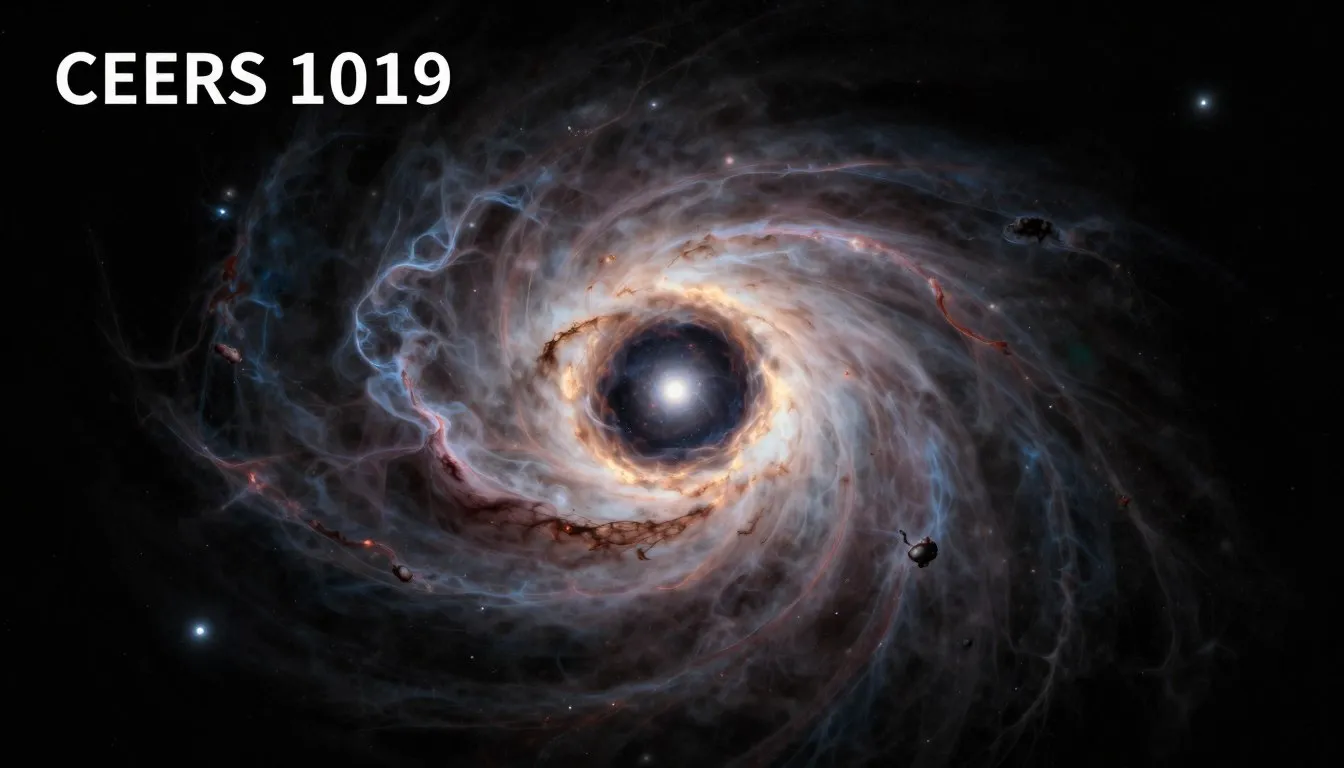
Somewhere in the young universe, a black hole was already feeding on gas and shining with remarkable power. The James Webb Space Telescope has found the most distant black hole of its kind, inside a galaxy known as CEERS 1019.
The galaxy existed only about 570 million years after the Big Bang. Its discovery gives astronomers a rare view of cosmic history, when the first galaxies and black holes were still taking shape.
A Record Set by James Webb Space
CEERS 1019 is an active supermassive black hole. It is surrounded by matter that falls inward and releases energy. This process makes the central region bright enough for a space telescope to detect across billions of light-years.
Researchers estimate that the black hole has a mass about nine million times greater than the mass of the Sun. That is enormous by human standards, yet it is relatively small compared with many supermassive black holes found in later cosmic eras.
Some ancient black holes weigh more than a billion times the mass of the Sun. Their greater mass can make them brighter and easier to find. CEERS 1019 is different. Its modest size suggests that it may be closer to the original population of black holes formed from the first stars.
| Feature | CEERS 1019 | Later giant quasars |
|---|---|---|
| Cosmic age at observation | About 570 million years after the Big Bang | Usually seen at later stages of cosmic history |
| Estimated black hole mass | About 9 million times the Sun’s mass | Often more than 1 billion solar masses |
| Scientific value | Shows early growth at a moderate mass | Shows extreme growth and brightness |
This contrast matters. A black hole with nine million solar masses still needed to grow quickly. The finding challenges simple ideas about when black holes began forming and how fast they could gain mass.
Webb Data Reveal a Young Galaxy
The James Webb Space Telescope was designed to study faint infrared light from the distant universe. Because light takes time to travel, distant observations also show the past. The light from CEERS 1019 began its journey when the universe was less than one billion years old.
That makes the galaxy a valuable laboratory. Astronomers can examine its stars, gas, and central black hole during a period when the first galaxies were assembling. The Webb data also help researchers separate light from the host galaxy and light from the active black hole.
Earlier telescopes could find some bright objects from this era, but their observations often favored the biggest and most powerful black holes. Webb’s sensitivity allows scientists to study a less massive object that might represent a more common stage of early growth.
“This black hole is not as massive as other black holes in the early universe, but it is active at a very early time.” — Summary of the research team’s reported findings
The result shows the value of studying ordinary examples, not only cosmic extremes. A smaller black hole may provide clues about the population that later grew into billion-solar-mass objects.
Growth in the First Billion Years
Black holes do not shine on their own. Their surrounding accretion disks can glow when gas becomes extremely hot as it spirals inward. The light carries information about the black hole’s mass, feeding rate, and environment.
CEERS 1019 formed during a complicated stage of universal history. The first stars were changing their surroundings. Their deaths may have left behind early black holes. Merging galaxies could then have supplied new gas and helped those black holes grow.
Another possibility is that some early black holes began from unusually large seeds. These seeds might have formed when massive clouds of gas collapsed directly, instead of first becoming stars. The new observation cannot settle that question by itself, but it gives researchers a useful target for future study.
- It dates an active black hole to about 570 million years after the Big Bang.
- It measures a central mass near nine million Suns.
- It links black hole growth with the evolution of an early galaxy.
- It tests models of stars, gas, and galaxy formation.
Scientists also use gravitational lensing to study distant galaxies. A massive foreground galaxy can bend light and act like a natural magnifying glass. CEERS 1019 is important because Webb can examine it without relying only on that effect.
Fresh Questions for Cosmic History
The discovery does not mean current theories have failed. It means they must explain how a black hole could reach nine million solar masses so soon after the universe formed. Growth may have been faster, seeds may have been larger, or several processes may have worked together.
More observations will help. Webb can measure additional distant galaxies, compare their black holes, and search for objects that are even farther away. Researchers can also combine infrared data with X-ray observations from the Chandra X-ray Observatory.
Each new object adds a piece to the history of the universe. The goal is not only to find the black hole ever seen at the greatest distance. It is to understand how black holes, stars, and galaxies developed together over billions of years.
CEERS 1019 offers a clear look at a turning point in cosmic history. Its early age and moderate mass show that black hole growth began sooner than once expected. As Webb continues to study the distant universe, these ancient lights may reveal how the first galaxies became the structures we see today, including the Milky Way.